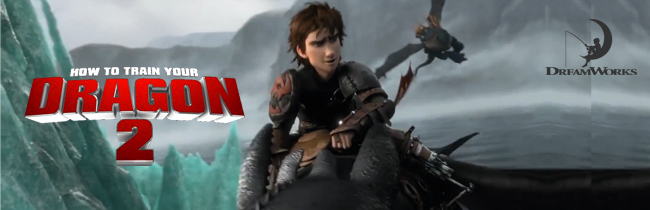
DreamWorks Animation Launches Character Poster for `How to Train Your Dragon 2’
DreamWorks Animation has released the first posters for How to Train Your Dragon 2 and declared that Cate Blanchett will voice a dragon protector.
February 06th, 2014
DreamWorks Animation has released the first posters for "How to Train Your Dragon 2" and declared that Cate Blanchett will voice a dragon protector.
most of the voice cast from the first How To Train Your Dragon will be returning for the sequel How to Train Your Dragon 2", including Jay Baruchel, Craig Ferguson, America Ferrera, Jonah Hill, Christopher Mintz-Plasse, TJ Miller and Kristen Wiig.
In the upcoming film "How to Train Your Dragon 2" Cate Blanchett is a dragon protector and Cate will play a woman who spent so much time with dragons that she is one. The role was written specifically for Blanchett.
"How to Train Your Dragon 2" has been five years since Hiccup and Toothless successfully united dragons and Vikings on the island of Berk. Cate Blanchett will protect those dragons.
In the box office, "How to Train Your Dragon" is not only the animation but also the acting.
DreamWorks Animation Hints at another “Shrek†Film
DreamWorks Animation declared that it was teaming with Merlin Entertainments to establish a “Shrek†themed visitor attraction, to be called Shrek’s Far Far Away Adventure, in London
Phenakistoscope (1831) A phenakistoscope disc by Eadweard Muybridge (1893).The phenakistoscope was an early animation device. It was invented in 1831 simultaneously by the Belgian Joseph Plateau and the Austrian Simon von Stampfer. It consists of a disk with a series of images, drawn on radii evenly spaced around the center of the disk. Slots are cut out of the disk on the same radii as the drawings, but at a different distance from the center. The device would be placed in front of a mirror and spun. As the phenakistoscope is spun, a viewer would look through the slots at the reflection of the drawings which would only become visible when a slot passes by the viewer's eye. This created the illusion of animation.