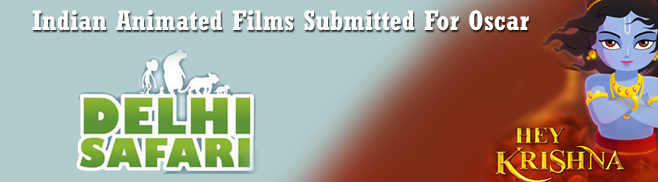
Indian animated movies Hey Krishna and Delhi Safari feature in the list that has been submitted for the 85th Academy Awards in the Animated Feature Film category.
January 19th, 2014
Indian
animated movies Hey Krishna and Delhi Safari feature in the list that
has been submitted for the 85th Academy Awards in the Animated Feature
Film category.
Directed
by Nikhil Advani, Delhi Safari is a 3D animation movie which follows
the story of a bunch of animal, who travels to Delhi to protect their
habitat. The film features voices of actors Akshaye Khanna, Govinda,
Suniel Shetty, Boman Irani, and Urmila Matondkar.
Hey Krishna (Krishna Aur Kans) is also a 3D film directed by Vikram Veturi.
A
total of 21 animated films have been submitted for the Oscar race.
Other movies which make it to the list are Wreck-It, Ralph, Brave,
Madagascar 3, Adventures in Zambezia, Dr Seuss The Lorax, Frankenweenie,
From Up on Poppy Hill, Hotel Transylvania, Ice Age Continental Drift, A
Liars Autobiography: The Untrue Story of Monty Pythons Graham Chapman
and The Mystical Laws.
Prime Focus Limited is the co-partner at FICCI FRAMES 2014. Federation of Indian Chambers of Commerce and Industry (FICCI) is Indias largest and oldest apex business organization and FRAMES which is in its 15th year, is Asias largest media and entertainment industry conclave covering Films, Broadcast TV & Radio, Digital Entertainment, Animation, Gaming and Visual Effects.
Phenakistoscope (1831) A phenakistoscope disc by Eadweard Muybridge (1893).The phenakistoscope was an early animation device. It was invented in 1831 simultaneously by the Belgian Joseph Plateau and the Austrian Simon von Stampfer. It consists of a disk with a series of images, drawn on radii evenly spaced around the center of the disk. Slots are cut out of the disk on the same radii as the drawings, but at a different distance from the center. The device would be placed in front of a mirror and spun. As the phenakistoscope is spun, a viewer would look through the slots at the reflection of the drawings which would only become visible when a slot passes by the viewer's eye. This created the illusion of animation.