MR. PEABODY & SHERMAN Saves the Future Animated Movie Trailer
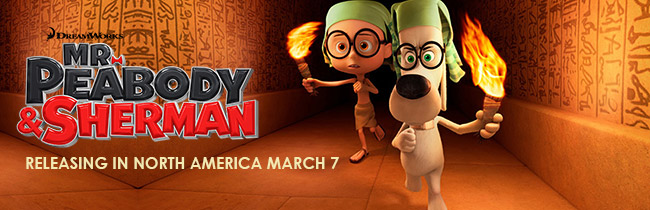
Mr. Peabody & Sherman is a DreamWorks 28th feature film and it is a 2014 movie
February 20th, 2014
Mr. Peabody & Sherman is a DreamWorks 28th feature film and it is a 2014 movie. It was released in the UK on 7th February 2014 and it will be released in North America on March 7th 2014. The movie was created by Ted Key and it is based on the 60’s animated television series “Peabody’s Improbable History”.
This funny animation is telling us the story of a genius dog and his adopted son Sherman. Mr. Peabody has a time machine, called the WABAC. Mr. Peabody and his adopted boy Sherman head back in time to experience world changing events first hand. But when Sherman and his classmate Penny breaks the rules of time travel, our two heroes find them in a race to repair history and save the future.
It is not only animated comedy movie, but it is teaching you a lot of interesting stuff about our world and history. It is a perfect movie for your children and adults.
Life of Pi was one of those novels that was considered impossible for film making. Pi was thought to be one of those books that was simply too complex to re-create.
Phenakistoscope (1831) A phenakistoscope disc by Eadweard Muybridge (1893).The phenakistoscope was an early animation device. It was invented in 1831 simultaneously by the Belgian Joseph Plateau and the Austrian Simon von Stampfer. It consists of a disk with a series of images, drawn on radii evenly spaced around the center of the disk. Slots are cut out of the disk on the same radii as the drawings, but at a different distance from the center. The device would be placed in front of a mirror and spun. As the phenakistoscope is spun, a viewer would look through the slots at the reflection of the drawings which would only become visible when a slot passes by the viewer's eye. This created the illusion of animation.