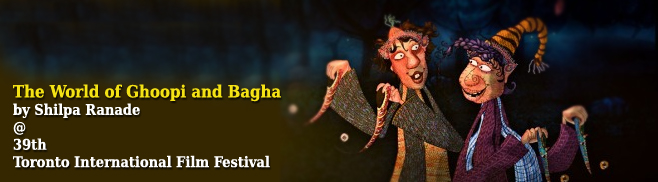
The World of Ghoopi and Bagha @ 39th Toronto International Film Festival
The animation film The World of Ghoopi and Bagha by Shilpa Ranade is being screened in the 39th Toronto International Film Festival s Kids section.
January 20th, 2014
The animation film The World of Ghoopi and Bagha by Shilpa Ranade
is being screened in the 39th Toronto International Film Festival s Kids
section.
The film is based on Satyajit Ray s
live action 1969 Bengali language children s musical Goopy Gyne Bagha
Byne . The original was based on a story told by Ray s grandfather. The
animation film has been made for the Children s Film Society, India.
Ranade
s film has been announced in the update list of more than a dozen films
from Asia in various sections announced now, doubling the size of this
year s Asian selection.
Chitralekhan 2014 in Karnataka Chitrakala Parishath, Bangalore
Maya Academy of Advanced Cinematics (MAAC) is an Indias leading 3D animation and VFX institute, joins hands with Karnataka Chitrakala Parishath (CKP) to present ‘Chitralekhan 2014’.
Phenakistoscope (1831) A phenakistoscope disc by Eadweard Muybridge (1893).The phenakistoscope was an early animation device. It was invented in 1831 simultaneously by the Belgian Joseph Plateau and the Austrian Simon von Stampfer. It consists of a disk with a series of images, drawn on radii evenly spaced around the center of the disk. Slots are cut out of the disk on the same radii as the drawings, but at a different distance from the center. The device would be placed in front of a mirror and spun. As the phenakistoscope is spun, a viewer would look through the slots at the reflection of the drawings which would only become visible when a slot passes by the viewer's eye. This created the illusion of animation.