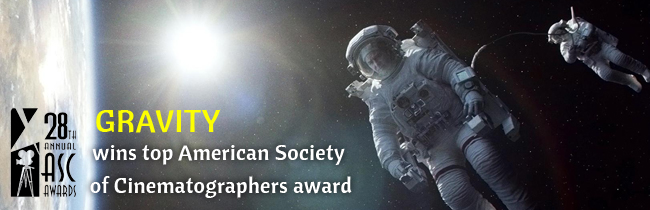
‘Gravity’ wins top American Society of Cinematographers award
The Gravity movie cinematographer Emmanuel Lubezki won top honors from the American Society of Cinematographers for his work on Gravity, it was announced at a ceremony tonight. It’s his third win from the group after Children of Men and The Tree of Life.
February 06th, 2014
The Gravity movie cinematographer Emmanuel Lubezki won top honors from the American Society of Cinematographers for his work on "Gravity," it was announced at a ceremony tonight. It’s his third win from the group after "Children of Men" and "The Tree of Life."
The ASC had seven nominees in the category, more than ever before, with Oscar nominees “Gravity,” “The Grandmaster,” “Inside Llewyn Davis,” “Nebraska” and “Prisoners” joined by “Captain Phillips” and “12 Years a Slave.”
The below list are the winners in film and television categories:
Best Cinematography in a Theatrical Release: Emmanuel Lubezki, "Gravity"
ASC Spotlight Award: Ryszard Lenczewski and Lukasz Zal, "Ida"
Television Film or Miniseries: Jeremy Benning, "Killing Lincoln"
One-Hour Episodic Series: Jonathan Freeman, "Game of Thrones" ("Valar Dohaeris")
Disney’s Frozen is being re-released in India AGAIN!!
Disney’s Animated movie Frozen 3D was re- released in India on31 January 2014. Recently, It has won the best animated feature film award at Golden Globes.
Phenakistoscope (1831) A phenakistoscope disc by Eadweard Muybridge (1893).The phenakistoscope was an early animation device. It was invented in 1831 simultaneously by the Belgian Joseph Plateau and the Austrian Simon von Stampfer. It consists of a disk with a series of images, drawn on radii evenly spaced around the center of the disk. Slots are cut out of the disk on the same radii as the drawings, but at a different distance from the center. The device would be placed in front of a mirror and spun. As the phenakistoscope is spun, a viewer would look through the slots at the reflection of the drawings which would only become visible when a slot passes by the viewer's eye. This created the illusion of animation.