Japanese gamers lastly get their hands on Sony’s PS4
Finally, Japan’s console gamers are getting their hands on the PlayStation 4 (PS4)
February 25th, 2014
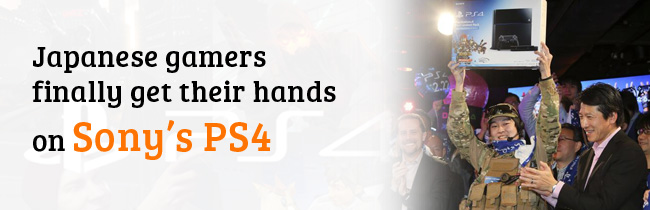
Finally, Japan’s console gamers are getting their hands on the PlayStation 4 (PS4). Sony’s next-gen console has been raking in the sales and soundly beating Microsoft’s Xbox One at it with the Japanese console makers selecting to establish the PS4 to the US and European market first before actually launching it in Japan. Those who desired to be the first to get Sony’s newfangled next-gen console lined up at the Sony Building, situated in the posh Ginza district of Tokyo, even two days before the launch date.
At midnight on February 22, the first 100 clients were given the privilege to take home the new video game console, putting those who lined up in the cold ahead of a across the nation mass release just a few hours later. The PS4 has proved a hit so far, selling 4.2 million units globally last year, outpacing rival Microsoft Corp.’s Xbox One at 3 million.
Join Toon Boom experts Stacey Eberschlag and Bernard Boiteaux in collaboration with Rahul Commerce for an evening of inspiration and refreshments!
Bernard will talk about the state of the industry, the future of animation and the many opportunities for India’s Animation Digital Content market. Stacey will show you the latest releases of Toon Boom Harmony and Storyboard Pro, demonstrating how they can benefit your studio with increased profitability and enhanced production tools and efficien
Phenakistoscope (1831) A phenakistoscope disc by Eadweard Muybridge (1893).The phenakistoscope was an early animation device. It was invented in 1831 simultaneously by the Belgian Joseph Plateau and the Austrian Simon von Stampfer. It consists of a disk with a series of images, drawn on radii evenly spaced around the center of the disk. Slots are cut out of the disk on the same radii as the drawings, but at a different distance from the center. The device would be placed in front of a mirror and spun. As the phenakistoscope is spun, a viewer would look through the slots at the reflection of the drawings which would only become visible when a slot passes by the viewer's eye. This created the illusion of animation.






 Finally, Japan’s console gamers are getting their hands on the PlayStation 4 (PS4). Sony’s next-gen console has been raking in the sales and soundly beating Microsoft’s Xbox One at it with the Japanese console makers selecting to establish the PS4 to the US and European market first before actually launching it in Japan. Those who desired to be the first to get Sony’s newfangled next-gen console lined up at the Sony Building, situated in the posh Ginza district of Tokyo, even two days before the launch date.